Buck's Dog Training Academy
The only dog-trainer certification
that ends in a business of your own.
Thirty days in person at Buck's HQ, training real client dogs under Nicole Buck — the founder who wrote the method. Pass a four-part exam you can actually fail, and you're eligible to open your own Buck's location on a proven brand. No other trainer school ends that way.
Foundation certification (CBDT) unlocks eligibility to open your own Buck's location.
Certified Buck's Dog Trainer (CBDT)
tuition, all in · finance in-house from $2,000/mo
What passing unlocks
Eligibility to open your own Buck's location
dogs graduated from a Buck’s program
client families served
certifications across seven tracks and three levels
You are not buying into a plan. Buck's is a working business with a full kennel and a floor staffed by people who came through this exact program — and it is the same floor you will train on for thirty days.
Read the whole curriculum before you apply.
Every certification runs in two stages: a self-paced online course you work through from home, then a 30-day in-person residency at HQ.
Most programs describe their curriculum. Here is ours — all 30 days of the Certified Buck's Dog Trainer, every topic, in order, and below it the exam that decides whether you keep the credential. Judge the program on what it actually teaches, not on how we describe it.
days of scheduled instruction
topics in this program alone
of contact time, summed from the schedule
Orientation, Buck's balanced-training philosophy, and immediate hands-on dog work with the slip lead.
- Buck's methodology and the balanced-training defenselecture
- Slip lead — anatomy, mechanics, fitlecture
- Live slip-lead lab — walk every facility doglab
We'll put our price next to everyone else's.
Most programs in this industry make you ask. Here is what a seat costs, next to what every other route into this business costs — the schools that teach the craft, and the franchises that sell the business. Buck's is the only one that does both.
Every one of these teaches you to train dogs. None of them ends with a business you own, a territory, or a brand clients already know. You finish, and you start from zero.
| Program | What it is | Cost to enter | Ends in a business |
|---|---|---|---|
| Buck's Dog Training Academy | 30 days in person, published syllabus | $25,000 | Yes |
| Animal Behavior College | Online coursework + local mentorship | $2,899 – $5,647 | No |
| Karen Pryor Academy | Six months, online with four in-person weekends | ~$5,300 | No |
| The Dog Trainer College | Five stacked courses | $6,300 | No |
| Academy of Pet Careers | Five months in person | $10,512 – $21,900 | No |
Figures are each brand’s own published tuition, franchise fee, or Item 7 total-investment range, as verified in August 2026. They are costs of entry, not statements about what any operator earns. Comparison programs are independent businesses with no affiliation to Buck’s.
It is the whole cost of the credential
Tuition, instruction, assessment and the textbook you keep. Lodging and travel for the thirty days are on you.
Your deposit is not an extra
The $5,000 acceptance deposit holds your seat and is credited toward tuition.
Financed in-house, by us
About $2,000/mo over roughly 11 months on the balance after your deposit at 9.99% APR. No bank, no broker. There is no separate annual recert charge for operators.
And price is the smaller half of the difference.
The certifications in this industry are honest programs that teach real skills. They just stop at the skill. Here is the gap between finishing a course and being ready to run a business under your own name.
Is this you?
We admit a small cohort and coach every student personally, so fit matters. Be honest with yourself.
This is for you if…
- You love dogs and want to build a business around them
- You’re ready to bet on yourself and do the 30 days in person
- You want a credential that commands premium prices, not a wall decoration
- You’d rather run a proven brand than gamble on a from-scratch startup
It's probably not for you if…
The path, end to end
From the application you have not started yet to the door of your own location. Nothing here is skipped, and the last stage is not automatic.
- Stage 1
Admissions — a real screen
Nicole reviews every applicant personally. Most of this stage is us finding out whether we would be proud to see you carry the name.
- 1Apply and send your résuméAbout fifteen minutes, plus a $10 application fee. PDF, Word document, or a clear photo of it.
- 2The questionnaireWork style and scenario judgement — how you would handle a real situation on the floor. It is read by a person, not scored by a machine.
- 3Background checkYou authorise it and we run it. The $250 screening fee pays for the checks themselves and is credited toward your tuition if you are accepted.
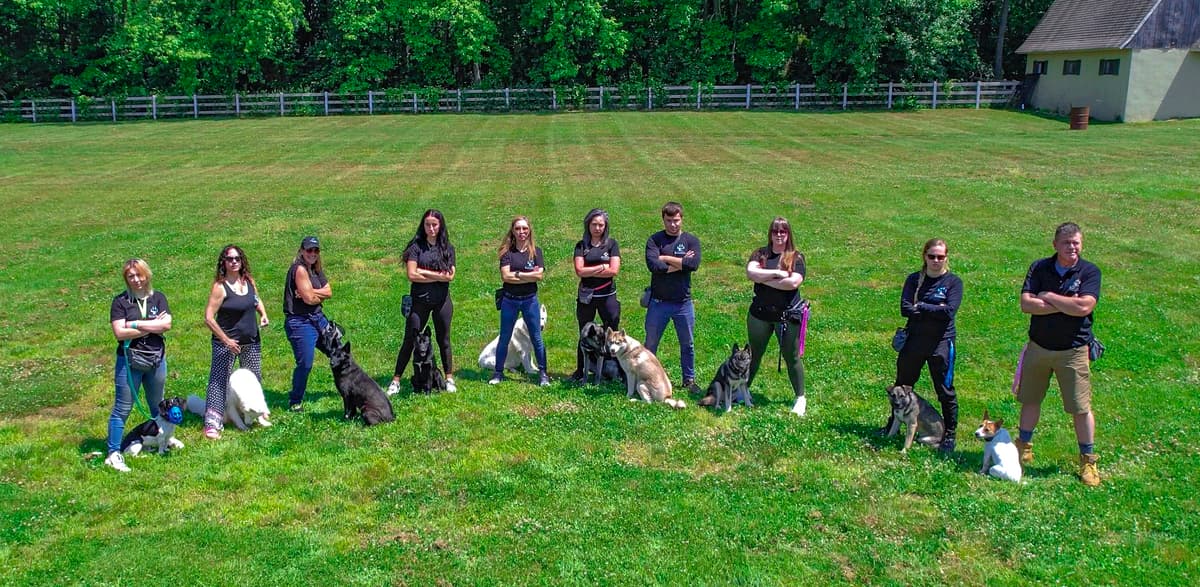
Taught by the founder — not a faceless course.
Nicole Buck built the entire 21-credential system and teaches it herself. She personally reviews every cohort application and runs the certifying assessment. You learn her balanced method hands-on — every effective, humane tool taught as communication — and your credential is numbered and founder-signed, not printed in bulk. When you carry the Buck's name, it means you trained with the person who built it.
- Nearly 30 years of balanced-training experience
- Thirteen years and thousands of cases running Buck’s
- Approved AKC Canine Good Citizen Evaluator
- Architect of the methodology the whole network trains on
Buck's balanced, tone-based system — taught end to end.
You graduate fluent in the full toolbox, taught as communication — not locked into a single ideology. Clear cues, fair corrections, and a repeatable progression that gets dogs go-home ready.
Tone is the cue
The tone (beep) means “comply.” The e-collar is conditioned so a tap reads exactly like leash pressure — clear communication first. It is used for punishment too, but only on a command the dog already knows and chooses to ignore.
Three clear markers
Yes, No, and Break. Yes is the clicker — it marks the instant the dog got it right and pays, and the dog is still working. No means the dog missed, is still working, and a correction follows. Break is the only release. Never a correction paired with a marker.
A 5-step progression
Every command runs the same five steps — introduce, build understanding, condition, phase out the leash and lure, then proof against the 3 D’s until it’s go-home ready.
Fair corrections only
A correction is only ever for a KNOWN command the dog chooses to ignore — never one it’s still learning — and always at the lowest effective level.
A clean command canon
One word per job. “Out” is the single disengagement cue; “Come” is recall. No overlapping cues to confuse the dog or the handler.
Trade the job you tolerate for the dogs you love.
The people who thrive here are not looking for a class. They want a career they own — real skill, a name clients already trust, and work that changes dogs' lives and keeps families together. That is what a license is for. It is a real opportunity with real backing behind it, and a real bar to clear — Stage 4 above is a separate, earned step, not a diploma perk.
Your own protected territory
A market that’s yours to build — no other Buck’s competing for the same clients.
A brand clients already trust
Skip the years it takes to build a name. You open under a reputation that’s already earning.
7 tracks, three levels — one catalog
Start with the General foundation: it is the credential that unlocks eligibility to open your own location, and the prerequisite for every specialty. Then choose how you grow — sideways into a new discipline, or up the ladder into a bigger operation.
General
The foundation the whole system is built on: obedience, behavior, board-and-train, and the business of running a Buck’s location. Tools are introduced in the first three days and used every day after, with theory, tools and handling interleaved daily.
You can offer: Board-and-train, private lessons, group classes and day training — and it is the prerequisite for all six specialties.
Agility
Buck’s own agility system — confidence before speed — plus the three major external handling systems, taught so you can continue a client who arrives on one of them. Full obstacle inventory, conditioning and injury prevention, biomechanics, and AKC, USDAA and UKI rule sets.
You can offer: Agility classes, private handling lessons and trial prep. Renewal includes running a novice course at speed.
Straight answers
I don’t have any experience — can I still do this?+
Yes. The General foundation (CBDT) has no prerequisite and is open to admitted applicants. You’ll learn the craft from the ground up on real dogs.
What if I don’t pass the exam?+
Day 30 holds make-up retests for any single modality you don’t pass on the first attempt. We want you certified — we just hold the standard while you get there.
Isn’t the tuition a lot?+
It is a serious number, and we put it on the page rather than making you ask. Two things are worth knowing. First, it is the whole cost of the credential — $25,000 — financeable in-house at about $2,000/mo, so you can certify now and pay as you go. Second, compare it to what it costs to enter this industry any other way: buying a dog-training franchise starts around $50,000 and runs past $460,000 for a facility build. We don’t publish income projections, and we won’t — what an operator earns depends on their market and their work, and any financial performance information belongs in the Franchise Disclosure Document, not on a landing page.
Do I have to be there in person?+
Yes — it’s a 30-day residential at HQ in Mullica Hill, NJ, 08:00–17:00 daily. There is no video shortcut. Students often share a nearby rental; lodging and travel are on you.
Talk to admissions before you apply.
Applying is a real commitment, and you should have your questions answered first. Tell us where you're at and someone from admissions will get back to you with the full breakdown — programs, tuition and financing, cohort dates, and exactly how the licensee path works. No obligation, no pressure, no cost.
- A real person from admissions, not a bot
- Straight answers on cost, financing, and the ROI
- First to hear when the next cohort opens
Checking times…
Or just send your questions
The next cohort is filling now
Seats are limited and admissions take a few weeks — a résumé, a questionnaire, a background check and a conversation with Nicole. The sooner you start, the sooner you are standing on the floor.