Seven tracks, three levels each. Start with the General foundation (CBDT) — it unlocks your own Buck's location — then stack specialties, each a new service line you can charge premium rates for. Every program is a 30-day in-person residential at HQ.
And every track climbs the same three-level ladder — each level raises your kennel ceiling, your team, your territory, and your authority. Here's how far it goes.
Every track climbs the same ladder. Each level raises your kennel ceiling, your team, your territory, and your authority — you decide how far you take it.
Certified Buck’s Dog Trainer (CBDT)
The foundation — it turns you from a trainer into an owner.
What it authorizes
Earned by: General L1 (CBDT) has no prerequisite. The six specialty T1s require an active CBDT first.
Senior Buck’s Dog Trainer (SBDT)
Twice the kennel, a real team, and the authority to lead and mentor.
Master Buck’s Dog Trainer (MBDT)
Master your craft and lead a region — you don’t just run a location, you develop the trainers around you.
About kennel numbers: Your certification level sets the maximum number of dogs your kennel may hold at once — 5 at L1, 10 at L2, 20 at L3. You tell us how many you actually want to run within that ceiling. The number is a capacity limit set by your level, not a guarantee that a set number of dogs will be provided or booked.
Two separate stages: an online theory gate that earns your cohort invitation, then the in-person four-modality exam you sit at HQ. Every program — every track, every level — uses this same flow.
Stage 1 · before your cohort
Once you're invited, you complete a self-paced online course and pass three written finals. Passing all three is the prerequisite that unlocks your cohort — it proves you're theory-ready. It is not a substitute for the in-person exam.
Learning theory (the four quadrants, operant & classical conditioning), marker theory & timing, the tone-based method and its 5-step progression, the correction rule, the e-collar working-level concept, the command canon, tool mechanics (slip / prong / e-collar), ethology, body language, health & welfare, and behavior modification.
Running a Buck’s location — intake mastery, treatment planning & prognosis, packages & pricing, the licensing model, client comms and hard conversations, kennel operations, staffing, the ERP systems, and compliance & safety.
Start with the General foundation — it unlocks your own location — then stack specialties. Each is a distinct service line you can offer clients.
The foundation the whole system is built on: obedience, behavior, board-and-train, and the business of running a Buck’s location. Tools are introduced in the first three days and used every day after, with theory, tools and handling interleaved daily.
You can offer: Board-and-train, private lessons, group classes and day training — and it is the prerequisite for all six specialties.
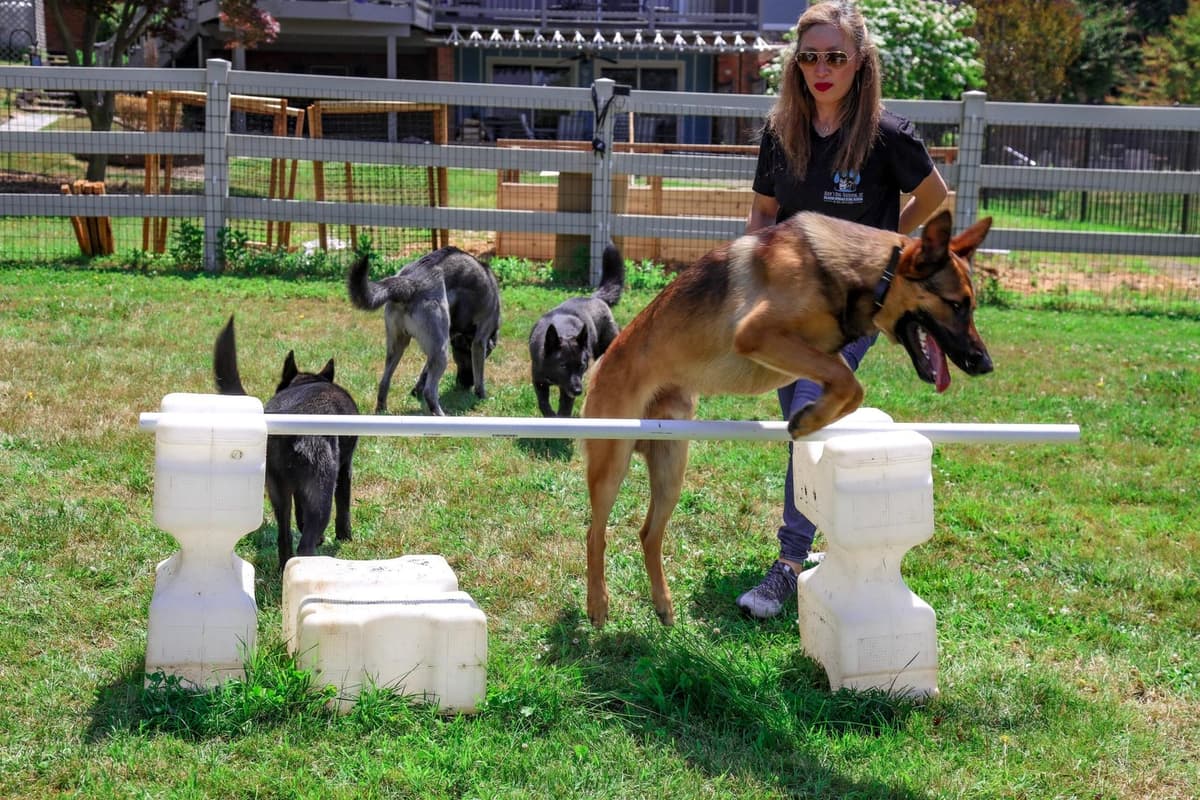
Buck’s own agility system — confidence before speed — plus the three major external handling systems, taught so you can continue a client who arrives on one of them. Full obstacle inventory, conditioning and injury prevention, biomechanics, and AKC, USDAA and UKI rule sets.
You can offer: Agility classes, private handling lessons and trial prep. Renewal includes running a novice course at speed.
Free-shaping mastery, thirty-plus trick foundations, behavior chains, choreography and portfolio filming, mapped onto the AKC Trick Dog ladder from Novice through Elite Performer. The most reinforcement-positive track we teach — compulsion is rarely the right answer here.
You can offer: Trick and freestyle classes and AKC title prep. Renewal is a three-minute routine performed with your own dog.
The reactivity and aggression casework most trainers turn away: bite-risk management and the six-level bite scale, threshold work, muzzle conditioning, the Out-and-redirect protocol, working alongside veterinary behaviorists, and writing an honest prognosis.
The entry credential of the Buck's certification system — a 30-day in-person residential bootcamp. Tools (slip lead, prong, e-collar) are introduced on Days 1-3 and used every day after; theory, tools, and handling interleave daily. Graduates earn the right to apply for a Buck's full-service franchise (Nicole reviews and provisions) and to be hired as a Buck's-branded trainer at any location. The four-modality assessment battery (written, informational oral, behavioral observation, physical practical) is administered in person in Week 4; a self-paced online course with three written finals is the prerequisite that earns the cohort invitation. Cert expires one year after issuance; renewal is an in-person evaluation (in person or in the field) plus an online exam.
Senior Buck's Dog Trainer — the year-2 credential. 30-day in-person residential. Prerequisites: General L1 issued at least 24 months prior, 3,000+ logged training hours post-L1, 150+ documented client cases with outcome tracking, sign-off from an MBDT on case portfolio, and a passing performance review from the trainee's current location. The curriculum assumes complete fluency on foundation skills and tools; this 30 days is about advanced behavior modification depth, group class mastery, B&T pipeline ownership, multi-handler transfer, and mentoring junior trainers. Graduates earn lead-trainer authority at a franchise plus the right to grade L1 candidates. Annual renewal includes a 3-day in-person practical.
What it authorizes
Earned by: The matching L1/T1 in your track, plus experience gates — 2,000–3,000 training hours, 50–150 coached cases, and 24 months at the lower level.
What it authorizes
Earned by: The matching L2/T2 in your track, plus stricter gates — 8,000–10,000 hours, 200–500 cases, 36 months tenure, a 12-month mentorship of a junior candidate, external evidence (e.g. a championship title), and a published capstone.
How the method, the tools, the business, and the ERP fit together — edge-case decision-making, methodology defense, bite & safety protocols, off-leash transitions & proofing, service-dog work, and the specialty-track landscape.
Pass all three → you earn your cohort invitation.
Stage 2 · at your 30-day cohort
The certification itself is earned entirely in person. All four modalities — including the written — are sat at HQ. You pass all four to certify, and annual renewal runs the same battery.
Closed-book multiple-choice + short-answer cumulative exam, sat in person.
Structured oral exam with 1–2 instructors, closed-book.
Live observation teaching or coaching a real beginner team.
Multi-station live-dog demonstration of hands-on skills.
Pass all four → you're certified.
You can offer: Rehabilitation cases — the practical exam includes a graded bite-ladder board, and renewal is a high-stakes practical on real reactive dogs.
Task training across disability categories, public-access mastery to an ADI-equivalent Public Access Test, and the legal frame a service-dog trainer is held to — ADA, FHA, ACAA and DOT.
You can offer: Owner-trained service-dog programs and public-access preparation. The renewal exam is heavier on legal scenarios than any other track.
Detection and nosework end to end: odor imprinting on birch, anise, clove and cypress; container, interior, exterior, vehicle and buried searches; passive versus aggressive indication; and reading your dog. The AKC Scent Work and NACSW pathways are the titling venues, not the method.
You can offer: Nosework classes, detection foundations and trial preparation. Renewal is a blind interior search on a single hide.
Protection WORK, not sport — grounded in military and police K9 practice. Drive development, grip and bite work, the Out as a non-negotiable release, bark-and-hold, apprehension and the call-off, decoy safety, and the state-by-state liability frame. Sport venues are taught only as context a trainer should recognise.
You can offer: Handler-protection and protection dogs, including the owner vetting and deployment law that go with them.
Every specialty requires an active General L1 (CBDT) first, and each track runs three levels — entry, senior, and master.
Agility T1 — entry-level specialty for agility trainers. 30-day in-person residential. Builds on General L1 foundation. Teaches Buck's home-grown agility system (AKC-regulation-grounded, assembled from the proven pieces of every successful style, cued the Buck's way, confidence-before-speed) as the house primary, with the three major external systems (path-based, cue-based, and European path-reading — attributed in the program references) taught for client-continuation. Heavy obstacle inventory training, conditioning & injury prevention, biomechanics, AKC/USDAA/UKI rules. Graduates earn the right to apply for an agility-discipline franchise (Nicole reviews and provisions). Annual renewal — in-person evaluation includes running a novice course at speed.
Senior Agility Trainer — year-2 specialty credential. 30-day in-person residential. Prerequisites: Agility T1 ≥24 months prior, 2+ years coaching experience, and a competition record (titled at Open/Excellent or equivalent — handler or student). Buck's home-grown system (AKC-grounded, assembled from the proven pieces of every successful style, confidence-before-speed) remains the house primary at every tier; external practitioners are cited only as sources of specific proven techniques. The curriculum covers international course style (FCI/EO/AWC), distance handling, advanced obstacle troubleshooting (especially weave depth/entries), contact behavior rehabilitation, conditioning periodization, and sport-specific nutrition. Graduates earn lead-instructor authority at an agility franchise and the right to grade T1 candidates. Annual renewal includes running international-style courses under time.
Master Agility Trainer — apex agility credential. 30-day in-person residential. Prerequisites: Agility T2 ≥36 months prior (5 years total since T1), MACH/ADCH on multiple dogs OR competition at AKC Nationals / USDAA Nationals / equivalent, 12 months mentorship under existing MAT, capstone (published case study or research-grade write-up). Curriculum: national team coaching, judging-track eligibility, course design authority, biomechanics research, multi-discipline integration, agility program governance. Buck's home-grown system remains the house primary at every tier; a master coaches a client in whatever system they run without converting them, but the house method they steward and teach is Buck's own.
Trick T1 — entry-level trick training specialty. 30-day in-person residential. Builds on General L1. Free-shaping mastery, AKC Trick Dog program (Novice TKN → Intermediate TKI → Advanced TKA → Performer TKP → Elite Performer TKE — five levels; see akc.org/sports/trick-dog), 30+ trick foundations, choreography intro, behavior chains, filming/portfolio. Trick training is the most reinforcement-positive specialty — compulsion is rarely the right answer. Graduates earn the right to apply for a trick-discipline franchise (Nicole reviews and provisions). Annual renewal includes performing a 3-minute routine with own dog.
Senior Trick Trainer — year-2 specialty credential. 30-day in-person residential. Prerequisites: Trick T1 ≥24 months prior, AKC Trick Dog Elite Performer title on at least one dog OR stage/screen credit. Curriculum: choreography depth, multi-dog routines, performance dog development, on-set behavior, prop construction & safety, advanced behavior chains 10+ steps, costume work. Graduates earn lead-instructor authority at a trick franchise and grade T1 candidates.
Master Trick Trainer — apex trick credential. 30-day in-person residential. Prerequisites: Trick T2 ≥36 months prior (5 years total since T1), measurable industry impact (stage credits, TV credits, world records, recognized educational reach), 12 months mentorship under existing MTT, capstone. Curriculum: stunt dog pipeline, multi-dog choreography at scale, film/TV agent partnerships, world-record protocols, curriculum authoring for T1/T2, multi-location ops.
Behavior Modification T1 — entry-level specialty for trainers working with reactive and aggressive dogs. 30-day in-person residential. Builds on General L1. Heavy emphasis on bite-risk management, the 6-level bite scale, Buck's Out-and-redirect + BAT 2.0 / CAT protocols, threshold management, muzzle conditioning, working with vet behaviorists, and honest prognosis writing. The four-modality assessment includes a bite-ladder practical (graded ability to read and respond at each escalation level). Graduates earn the right to apply for a behavior-modification-discipline franchise (Nicole reviews and provisions). Annual renewal includes a high-stakes practical with reactive case dogs.
Senior Behavior Modification Trainer — year-2 specialty credential. 30-day in-person residential. Prerequisites: Behavior Modification T1 ≥24 months prior, 75+ documented reactive cases with outcome tracking. Curriculum: working with vet behaviorists on medicated cases, predatory drift, conflict aggression nuances, bite-history rehabilitation, BE counseling depth, dangerous-dog law by state, rehoming assessments, household integration of inter-dog aggression. Graduates earn lead-trainer authority at behavior-modification franchises and grade T1 candidates.
Master Behavior Modification Trainer — apex reactive credential. 30-day in-person residential. Prerequisites: Behavior Modification T2 ≥36 months prior (5 years total since T1), 250+ high-risk reactive cases including bite-history, 12 months mentorship under existing MBMT, capstone. Curriculum: expert witness work in bite litigation, shelter behavior consulting (SAFER, Meet Your Match), aggression research literacy, breed-specific aggression evidence base, dangerous-dog policy advocacy, multi-location behavior-modification ops.
Service Dog T1 — the entry-level specialty for service-dog trainers, 30-day in-person residential. Builds on General L1 foundation; this program is exclusively SD-specific content. Heavy emphasis on legal framework (ADA, FHA, ACAA, DOT), task training across disability categories, public access mastery, and the ADI-equivalent Public Access Test. Graduates earn the right to apply for a service-dog-discipline franchise (Nicole reviews and provisions). Annual renewal required; renewal exam is heavier on legal scenario content than any other track.
Senior Service Dog Trainer — year-2 SD specialty. 30-day in-person residential. Prerequisites: Service Dog T1 ≥24 months prior, 5+ teams placed (graduated to working handler) across at least 2 distinct disability categories. Curriculum: advanced task work (seizure, diabetic alert, full mobility, advanced psych), scent imprinting at depth, owner-trainer pipeline management, breeder partnerships, washout management, succession dogs, retired service dog conversion, nonprofit SD program ops, insurance.
Master Service Dog Trainer — apex SD credential. 30-day in-person residential. Prerequisites: Service Dog T2 ≥36 months prior (5 years total since T1), 20+ teams placed across multiple disability categories, 12 months mentorship under existing MSDT, capstone. Curriculum: ADI accreditation pipeline, program founding and governance, multi-disability program design, legislative and policy advocacy, expert witness in SD access cases, fundraising, board governance.
Scent T1 — entry-level scent-work specialty. 30-day in-person residential. Builds on General L1 foundation. Foundation odor introduction (birch, anise, clove, cypress), the AKC Scent Work titling pathway (Novice → Advanced → Excellent → Master) and NACSW K9 Nose Work program (ORT odor-recognition test first, then NW1 → NW2 → NW3 in succession; NW3 Elite requires three NW3 titles plus element competency, and the Elite Division then runs on accumulated points — ELT1/ELT2/ELT3/ELT-CH — with a Summit level above that; see nacsw.net rule book). Container / interior / exterior / vehicle / buried searches. Indication training (passive vs aggressive). Handler reading skills. Graduates earn the right to apply for a scent-discipline franchise (Nicole reviews and provisions). Annual renewal includes running a blind interior search with a single hide. AKC/NACSW are the titling venues, not the method. The house imprint is a play/prey-drive arc — towel tosses → residuals → hides — grounded in best-practice detection training (see the program references). The broader venue/odor technique detail is industry-standard detection practice compatible with that method and may be refined by the Training team via the cert CMS.
Senior Scent Trainer — year-2 specialty credential. 30-day in-person residential. Prerequisites: Scent T1 ≥24 months prior, 1,000 training hours, 75 coached cases, and a coached/handler title at Advanced or higher (AKC SWA, NACSW NW2, or equivalent). Curriculum covers Excellent / Master-level work, source-vs-residual scent, environmental complexity (HVAC, draft loads, contamination), trial judging fundamentals, mock blind judging, scent-detection theory at depth (physics of odor transport), and class delivery for mixed-level groups. Grounded in the house play/prey-drive imprint method (towel tosses → residuals → hides; reward at source; balanced, not force-free; false alerts extinguished by no-reward + criterion, never aversives on an offered alert; see the program references); AKC/NACSW are titling venues, not the method. Specific staging metrics may be refined by the Training team via the cert CMS.
Master Scent Trainer — top-tier specialty credential. 30-day in-person residential. Prerequisites: Scent T2 ≥36 months prior, 2,500 training hours, 250 coached cases, 12-month mentorship of a T2 candidate, and external evidence (titled at NACSW NW3/Elite or AKC Scent Work Master). Curriculum covers cross-track integration (scent + reactive, scent + service), seminar/workshop instruction at industry venues, judge-of-judges responsibilities, research literature engagement (peer-reviewed olfaction studies), and contribution to Buck's curriculum. Graduates earn the right to publicly teach Buck's methodology at non-Buck's venues — which means they must be able to state and defend it: the house play/prey-drive method (towel tosses → residuals → hides), reward at source, a balanced (not force-free) approach, and no aversives on an offered alert, with AKC/NACSW as titling venues rather than the method (see the program references). Specific staging metrics may be refined by the Training team via the cert CMS.
Protection T1 — entry-level protection-WORK specialty (this is protection work, NOT protection sport). 30-day in-person residential. Builds on General L1 foundation. Buck's protection method follows a drive-based style mixed with industry practices and is grounded mainly in MILITARY and POLICE K9 training methods: drive development (prey/hunt → defense/survival), grip and bite development, the OUT as the release/recoverability cue (built on the 5-step obedience foundation — recoverability is non-negotiable), guarding / bark-and-hold, apprehension and the call-off, control and recoverability under stress and pressure, handler protection, decoy/helper safety, and the US-state-specific legal and liability framework for protection dogs (owner vetting, deployment law, negligence exposure). Sport venues (IGP/PSA/Ring) are covered only as external context a trainer should recognize — Buck's does not train for sport bite-work. Graduates earn the right to apply for a protection-discipline franchise (Nicole reviews and provisions). Annual renewal includes a live-helper bite-and-out demonstration.
Senior Protection Trainer — year-2 protection-WORK credential (protection work, not sport). 30-day in-person residential. Prerequisites: Protection T1 ≥24 months prior, 1,000 training hours, 60 coached protection cases, and demonstrated protection-work competency (a fully green-to-finished protection dog produced or coached, evaluated on Buck's standard). Curriculum covers advanced protection-work construction grounded in military and police K9 methods (multi-phase bite development, guarding/apprehension, call-off and recoverability under heavy pressure, handler protection and building/vehicle scenarios), professional decoy/helper development, multi-dog handling, the advanced legal and liability landscape (state-by-state, deployment and negligence law), and lead-instructor responsibilities at a protection franchise. Sport venues are recognized as external context only. Buck's method follows a drive-based style + industry practices + military/police standards (see the program references).
Master Protection Trainer — top-tier protection-WORK credential (protection work, not sport). 30-day in-person residential. Prerequisites: Protection T2 ≥36 months prior, 2,500 training hours, 200 coached protection cases, 12-month mentorship of a T2 candidate, and external evidence of protection-work mastery (a body of finished protection dogs, and/or military/police/industry protection-training credentials or references). Curriculum covers mastery-level protection-work refinement to military/police standard, decoy/helper mastery and certification, cross-track integration (protection + scent for detection/decoy, or protection + reactive for civil-aggression cases), seminar instruction, contribution to Buck's curriculum, and industry-publication-level work. Graduates earn the right to publicly teach Buck's protection methodology (a drive-based style + industry practices + military/police methods; see the program references) at non-Buck's venues. Sport is recognized as external context only.